Met Museum Toah Works of Art Picasso Les Demoiselles Davignon
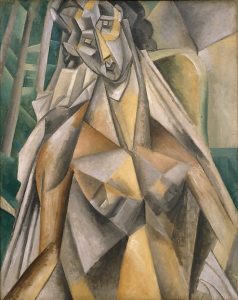
Pablo Picasso (Spanish, 1881–1973),Nude in an Armchair, summertime 1909, oil on canvass; 36 1/iv × 28 3/4 inches. Metropolitan Museum of Fine art
LINK: http://www.metmuseum.org/Collections/search-the-collections/490587
Cubism
Developed by Pablo Picasso and George Braque, Cubism is ane of the most significant developments in the history of mod art.
Pablo Picasso's route to Cubism began with the simplification of forms inspired past African masks and ancient sculpture. The painter George Braque, associated with the Fauves, was securely interested in the work of Paul Cézanne, the Post-Impressionist who relied on pure areas of blocky color rather than clearly defined linear forms that he then organized inside the sail disregarding perspectival accuracy.
The collaboration between Picasso and Braque in the evolution of Cubism is legendary in the history of art. Their intense working relationship lasted months in which the artists visited each other daily to discuss their work. Soon, they stopped signing their individual works and only alleged a painting finished when both agreed. Recognizing that what they were doing was the creation of something wholly new and modern, Picasso and Braque referred to each other jokingly equally Orville and Wilbur Wright, the American brothers who pioneered the development of flight a few years alee of the development of Cubism.
- For Cubism, download and use the 'Cubism worksheet (Word)' while doing the readings in the gild listed below. This worksheet will take you through each reading and video helping to gather, ascertain and organize fundamental information to understand Cubism. As you are reading, fill in information on the 'Cubism worksheet.' Bring your completed worksheet to class for in-class review.
- Get-go with the short essay on the Met'south website, giving you lot an overview of Cubism: http://world wide web.metmuseum.org/toah/hd/cube/hd_cube.htm
- Read another brusk essay that defines some key terms related to Cubism. Look up these terms on lexicon.com: simultaneity, conceptual and perceptional if yous are unclear near their exact meaning. LINK: http://arthistory.virtually.com/od/modernarthistory/a/cubism_10one.htm
Side by side, you are going to read various material relating to Cubism on the Khan Academy website, including:
- Read 'Picasso's Early Work' essay for an overview: https://www.khanacademy.org/humanities/art-1010/early-brainchild/cubism/a/picassos-early-piece of work
- Read 'Picasso, Portrait of Gertrude Stein.' Hither is where we see the beginning of Picasso's contribution to Cubism in how he simplifies his subject's facial features and treats her face up similar a flat, two-dimensional grade or a mask in some areas. https://world wide web.khanacademy.org/humanities/art-1010/early-abstraction/cubism/a/picasso-portrait-of-gertrude-stein
- Read 'Inventing Cubism' essay, where Braque'southward involvement in Cézanne leads to his contribution to Cubism. LINK: https://www.khanacademy.org/humanities/art-1010/early-abstraction/cubism/a/inventing-cubism
Picasso'southward Les Demoiselles d'Avignon:
Picasso'south painting Les Demoiselles d'Avignon is extremely meaning for the development of Cubism. Some ideas about Cubism are adult here, including the abbreviations of form influenced by African masks and sculptures and the get-go use of multiple visual perspectives or multiple points of view of the same object brought together inside one epitome. Other equally significant aspects of Cubism only come up later afterwards continued experimentation and collaboration with Braque.
- Read the essay about Picasso's Les Demoiselles d'Avignon paying special attention to the section about the perception of space. LINK: https://www.khanacademy.org/humanities/art-1010/early-abstraction/cubism/a/picasso-les-demoiselles-davignon
- Listen to the video of Picasso's Les Demoiselles d'Avignon . This video should serve to familiarize you with the painting within the context of art history. This video is not going to teach you about Cubism, but it will serve equally an introduction to major aspects of fine art history that Picasso rejects with this painting and how what he incorporates marks the showtime of Cubism. LINK:https://www.khanacademy.org/humanities/art-1010/early-abstraction/cubism/v/picasso-les-demoiselles-d-avignon-1907
- Listen to the video about Braque'southward painting The Viaduct at L'Estaque. LINK: https://www.khanacademy.org/humanities/art-1010/early-brainchild/cubism/5/braque-le-viaduc-l-estaque-the-viaduct-at-l-estaque-1908
- 'Analytic Cubism' is the name for the first phase that describes the two artists' fulfillment of the original goals and ideas nearly Cubism. Read the short treatment of Braque'southward portrait painting The Portuguese. LINK: https://www.khanacademy.org/humanities/art-1010/early-abstraction/cubism/a/braque-the-portuguese
- On the worksheet, add any relevant terms to the area about Analytic Cubism.
- Picasso'south Notwithstanding Life with Chair Caning is the beginning of the second phase of Cubism, the Synthetic Cubist stage. Read the essay that explains this transition and listen to the video about the artwork:
- Essay LINK:https://www.khanacademy.org/humanities/art-1010/early-abstraction/cubism/a/picasso-however-life-with-chair-caning
- Video LINK: https://www.khanacademy.org/humanities/art-1010/early-abstraction/cubism/five/picasso-still-life-with-chair-caning
On the worksheet, add any relevant terms to the area about Constructed Cubism.
- Optional: Heed to the videos about Picasso's 'Guitar, Glass, Bottle': LINK: https://www.khanacademy.org/humanities/art-1010/early-brainchild/cubism/v/moma-picasso-glassguitarbottle
- And Picasso's Guitar: LINK: https://www.khanacademy.org/humanities/art-1010/early on-abstraction/cubism/five/the-language-of-representation-pablo-picasso-s-guitar-1912-14
For form next calendar week – summary of the 1 required affair to practise :
- Read and take notes on Cubism using the worksheet. Bring the completed Cubism worksheetto course for in-class peer review.
- OPTIONAL: Read the information below most Orphic Cubism.
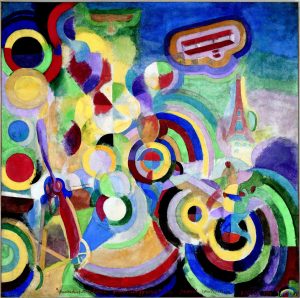 Robert Delaunay (French, 1885 – 1941), Homage to Bleriot, 1914, oil on canvass, 250 10 250 cm. Kunstmuseum Basel, Switzerland (Bleriot was the pilot of the showtime airline flying across the English language Aqueduct from Britain to France.)
Orphic Cubism (skim this textile to come across the visual influence of Cubism)
Orphic Cubism refers to several different artists. We will read and sentry short videos about Robert and Sonia Delaunay, František Kupka, Fernand Leger (primarily considered a Cubist), and Francis Picabia.
- Read overview about Orphic Cubism on Encyclopedia Brittanica online:
https://www.britannica.com/art/Orphism#ref53348
Continue notes on the most important data and concepts.
- Watch Khan Academy'due south video on Robert Delaunay's Simultaneous Contrasts: Sun and Moon: LINK: https://world wide web.khanacademy.org/humanities/art-1010/early on-abstraction/cubism/5/moma-simultaneous-contrasts-dominicus-moon
- Watch Khan University's video on Fernand Leger's Contrasts of Forms: LINK: https://world wide web.khanacademy.org/humanities/art-1010/early-abstraction/cubism/five/moma-contrast-of-forms
- Read brusk text nigh Sonia Delaunay on Tate Museum website: LINK:
http://world wide web.tate.org.uk/whats-on/tate-modern/exhibition/ey-exhibition-sonia-delaunay/delaunay-introduction
Read the following curt discussions of Sonia Delaunay, František Kupka and Francis Picabia that focus specifically on the evolution of these artists' Orphic Cubist works in terms of their interests in music.
Consider how music helped them find an equivalent in their visual imagery. Call back our discussion of the German Expressionist Vasily Kandinsky and his interest in the connections between brainchild and music?
The artworks referenced in these short essays are all included in the powerpoint for reference.
Sonia Delaunay
Born in the Ukraine in 1885 to a bourgeois family, Sonia Terk moved to Germany to study painting and in 1906, settled in Paris, where she met and married the painter Robert Delaunay. In 1911, she fabricated a quilted blanket from small scraps of fabric in an abstract system for their newborn son Charles. Sonia's believe in craft as non separate from or less important than the fine arts meant she subjected her well-nigh humble embroideries and quilts to the aforementioned rigorous colour theory that she and her hubby did in their paintings.
For the Delaunays, the constantly shifting play of light and colour in their urban surroundings was the central component of their art. Past purifying their images of overtly recognizable forms and focusing solely on this coaction, they were able to evoke the constant dynamism of optical stimulus in the modern metropolis, which they called the 'law of simultaneous contrasts' or simultaneity.
The poet and modern art critic Guillaume Apollinaire (who was a close friend of Picasso), became the spokesperson for the Delaunay's variation of Cubism, calling it Orphism after the aboriginal Greek hero who was a legendary musician and poet associated with divine and captivating music.
The Bal Bullier was a popular dance-hall located in the Latin Quarter where the Delaunays were regulars. It opened in the 1850s, was rebuilt after sustaining damages during the Franco-Prussian State of war in 1871, and outfitted with electric lighting at the plough of the century. When Sonia made her ambitious painting of the trip the light fantastic-hall, the Argentine tango and the American shimmy were especially pop dances. She recalled how "the continuing and undulating rhythm of the tango incited my colors to move."[i] Dancing couples appear underneath the electric lights with their simplified geometric forms recognizable past the dark colors representing the men'due south suits and the colorful overlapping forms of their female partners moving in pairs beyond the long horizontal canvas inspired by the vast surface area of the club's trip the light fantastic floor. To fully explore these visual effects, Sonia likewise made 'simultaneous' dresses and waistcoats to clothing to the Bal Bullier and later, she made these available for sale in local boutiques.
Later Robert's decease in 1941, Sonia continued to explore abstraction in textile designs and clothing sold at stylish section stores through the 1950s. She devoted many artworks to the discipline of jazz explored through the rhythm of colour combinations.
The Delaunay's son Charles grew up to be a jazz devotee who founded the Hot Guild de France, with a band that featured gypsy guitarist Django Reinhardt. Charles founded a mag called Le Jazz Hot with the beginning edition printed up on the back of a program for a performance past American saxophonist Coleman Hawkins in February 1935.[ii] During Globe War II, the Hot Club organized concerts to enhance money for out of work musicians.
František Kupka
František Kupka was a Czech-built-in artist who studied in Prague and Vienna, before making Paris his home in 1896. Like Vasily Kandinsky and Piet Mondrian, who too became leading abstract painters, Kupka expressed a philosophical and spiritual belief system with his not-representational imagery. The three artists were adherents of Theosophy, which sought to unite aspects of Western philosophy and Eastern religion to realize a universal harmony or utopian alternative to backer dystopia and divisive nationalism through the theosophical belief in a pervasive life force that is manifest specifically in nature and in brainchild.
The painting Amorpha, Fugue in 2 Colors, 1912, was Kupka's breakout painting and arguably the outset entirely not-representational artwork to be exhibited in Paris. Kupka selected the title to dissuade viewers from seeking literal subject field matter with the interwoven melodies of a musical fugue translated into the abstract human relationship between the bluish and carmine repeating circular forms that reflect Kupka'southward interest in regeneration. Similar Kandinsky, who also relinquished clearly recognizable motifs in his work at this time, Kupka felt that emotions, colors and music had synesthetic correspondences with the rhythm of an abstract limerick beingness as pure and expressive every bit music in promoting a heightened spiritual land of being.
Later, Kupka'south work changed to encompass machines and mechanization. He harnessed the tempo and energy of hot jazz and big band swing in the 1920s and 1930s, making paintings that reflect the effortless functionality of modern machinery with forms that appear livelier and bouncier than those representing the languid Baroque fugue. Kupka's paintings Jazz-Hot, no. 1 and Jazz-Hot, no. 2, both 1935, reflect his awareness of the hot jazz scene in Montmartre that developed in the 1920s, 'the Jazz Age' then-named by American expatriate author F. Scott Fitzgerald.
In the 1920s, hot jazz ensembles began featuring improvisatory solos within the larger composition that evoked the choreographed efficiency of machines working in-synch. For Kupka, these improvisatory solos were related to intuition, the key indication of a true artist who contributed something authentic to the pervasive life force that permeates all living things.
Francis Picabia
Francis Picabia was a leading fellow member of the Parisian avant-garde as well equally an international bon vivant with an oversized zest for life. Born in Paris in 1879, he was raised in an affluent conservative family. Initially, his work developed in line with the legacy of the Impressionists and the Mail service-Impressionists before Picabia set out to radicalize his work using the vocabulary of Cubism.
Picabia arrived in New York in January 1913 every bit a participant in the Armory Evidence, the landmark exhibition that brought modernistic fine art to American viewers for the starting time time. The exhibition featured over 300 artworks by leading European and American artists attracting over 250,000 visitors. Picabia'due south wife Gabrielle, a music pupil when they met, recalled being awed by the city's suspension bridges, dizzying skyscrapers, bustling traffic and crowded sidewalks. She recalled: "No sooner had we arrived than we became part of a motley international band which turned dark into day, careful objectors of all nationalities and walks of life living in an inconceivable orgy of sexuality, jazz and alcohol…we believed at first that we had returned to the blessed times of complete freedom of thought and activity."[iii]
It was at this time that Picabia first heard authentic American ragtime music performed live in a club. The music's event is seen in a serial of minor watercolor paintings made in 1913 showing how Picabia successfully interprets the rhythmic sound of the music into an interlocking Cubist vocabulary. In a newspaper interview given that year, Picabia explained how the music and urban stimulus of the city came together in his paintings: "I absorb these impressions. I am in no hurry to put them on sheet. I let them remain in my brain, then when the spirit of creation is at inundation-tide, I improvise my pictures every bit a musician improvises music."[four]
Footnotes:
[i] Anne Montfort, ed., Sonia Delaunay exhibition catalogue (London: Tate, 2015).
[two] William A. Shack, Harlem in Montmartre: A Paris Jazz Story between the Great Wars (Berkeley, Los Angeles and London: University of California Press, 2001), 96.
[three] Gabrielle Buffet-Picabia, "Some Memories of Pre-Dada: Picabia and Duchamp" (1949), included in Robert Motherwell, ed., The Dada Painters and Poets: An Anthology, 2nd edition (Cambridge & London: The Belknap Press of Harvard University Press, 1981), 259.
[iv] Francis Picabia, "How New York Looks To Me," in New York American, magazine section (March 30, 1913), 11; quoted in William A. Camfield, Francis Picabia: His Fine art, Life and Times (Princeton: Princeton University Press, 1979), 48.
Source: https://arh141.commons.gc.cuny.edu/week-7/
0 Response to "Met Museum Toah Works of Art Picasso Les Demoiselles Davignon"
Postar um comentário