What Would a Typical Meal Be for a Poor and Wealthy Family in Elizabethan England?

Elizabethan Food
Tudor Diet
The Elizabethans, like us, had three primary meals a day: breakfast, dinner, and supper. Breakfast was eaten early, unremarkably between 6-7am, dinner at midday, and supper betwixt 5-8pm. The kinds of nutrient eaten depended very much on wealth and condition. Poor people, in general, had humble and unvaried diets, whereas the rich of Elizabethan England ate well. They enjoyed all kinds of meat, including beef, pork, lamb, mutton, salary, veal, and deer, and fancy fowl such as peacock, swan, and goose. Their diet likewise included freshwater and sea fish, such every bit salmon, trout, eel, pike, and sturgeon, and shellfish such equally venereal, lobsters, oysters, cockels and mussels. For the poor, staff of life was the staple food and it would be eaten with butter, cheese, eggs, and pottage (a vegetable soup thickened with oats). Poor people could not beget much red meat, like beefiness or pork, so tended to eat white meat, like chicken, rabbit or hare, and birds they could catch like blackbirds or pigeons. As Queen Elizabeth fabricated a law in 1563 that compelled everyone to eat fish on Wednesdays, Fridays and Saturdays, the poor also regularly ate fish. This law was fabricated to support the fishing industry. Disobeying the law could mean upward to 3 months in jail!
The Elizabethans also ate fruit and vegetables. Some of the vegetables available to them were: turnips, parsnips, carrots, lettuce, cucumbers, cabbage, onions, leeks, spinach, radishes, garlic, and skirret (a pop root vegetable of the time). Some of the fruits eaten were: apples, pears, plums, cherries, lemons, raspberries, blackberries, melons, and strawberries. Expensive fruits, like peaches, oranges and pomegranates, were eaten only by the rich. Fruits were regarded with some suspicion in Tudor times, however, and were rarely eaten raw. They were mostly baked in tarts or pies or boiled to make jams. Indeed, pies were very pop in Tudor times and were eaten by rich and poor alike! The Tudors besides did not appreciate the nutritional value of vegetables and rich people, who had a vast amount of choice in food, didn't consume enough of them. It is thus one of history's ironies that the lower classes, who ate a lot of vegetables equally they could not beget meat, actually had a healthier diet!

Example of an Elizabethan Pie
Mary Arden's Farm
© Elizabethi.org
Nuts were also widely eaten in Tudor times, hazelnuts and walnuts being popular, and pulses such as peas, beans and lentils. Spices and herbs were used to season food and honey was the nigh mutual sweetener every bit sugar was very expensive. Nutmeg was very expensive as well.
As water was considered dangerous to drink, the Elizabethans drank ale instead. Even children drank ale as information technology was not very strong. Strong ale was reserved for times they wanted to make merry! The rich drank ale besides, but also vino, which was very expensive. Pop wines were claret, malmsey, and sack (a blazon of sherry). Milk was sometimes drank, sheep's aswell equally cow's, but was mostly used to brand butter, cream, and cheese.
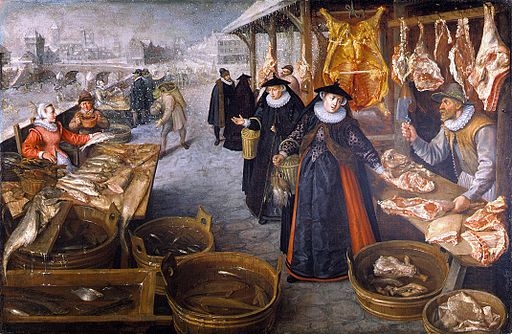 >
>
16th Century Market
Wiki Eatables
Over the course of the Tudor menstruum, more than and more than foods were introduced into society as they were discovered in the New Globe, such as tomatoes (or love apples as they were known) from Mexico; turkey from Mexico and Central America; kidney beans from Republic of peru, and of course the white potato famously brought to England by Sir Walter Raleigh in the later on years of Elizabeth's reign. Still, the Elizabethans did not know quite how to use or cook these foods to their optimum, then they were not as tasty as they could have been and tended to be kept as special delicacies.
Every bit well as a good repast, the Tudors were fond of desserts. They enjoyed pastries, tarts, cakes, cream, custard, and crystallized fruit and syrup. The rich, who could beget to buy sugar, were very fond of sugary desserts, so much so that their teeth turned black! In fact, having black teeth became such a status symbol that people would deliberately blacken their teeth so it looked like they were rich enough to buy sugar! Marzipan, known as marchpane, was also popular. For special feasts, or banquets, the rich would accept all kinds of novelties made out of sugar and marzipan, such as animals, birds, fruits and baskets. They would also sometimes take vino glasses, dishes, playing cards, and fifty-fifty trenchers fabricated out of a well-baked modelled sugar called carbohydrate-plate.
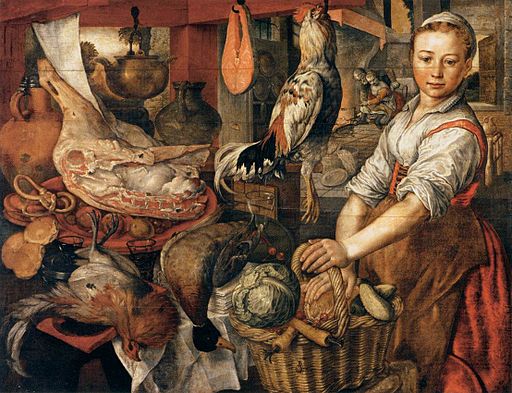
Preparing a Tudor Repast
Wiki Commons
Preparing meals was quite fourth dimension consuming in tudor times equally there were no ready meals! Housewives had to make pottage and pies from scratch, and cooking was over an open fire. Broths would be boiled in pans and meats would be roasted on a spit. The meat had to exist turned slowly to ensure even roasting and in the large kitchens of aristocratic households information technology was not uncommon to have a dog to do the task! These turnspit dogs (now extinct) were bred especially for the purpose and would be made to walk for hours inside a bike (similar to a hamster's wheel only much bigger) that slowly rotated the meat. The dogs were likewise used to power fruit presses and butter churns. To proceed the dogs moving, hot coal would sometimes be put into the wheel, or collars would be put onto the dogs that would choke them unless they kept walking.
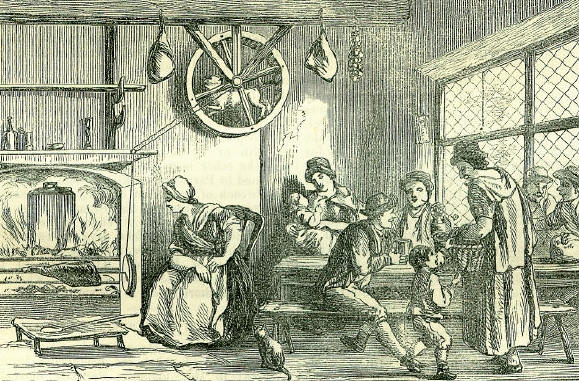
Turnspit domestic dog at work
Wiki Commons
In poor households, girls would help their mothers in the kitchen, learning the life skills they would later need as wives and mothers.
Bread was baked in an oven, generally made from rock or brick, just only the wealthy had their ain oven. The poor had to share a communal oven as their houses were fabricated of wood and were too small for i. The communal ovens would exist big, mayhap big enough to bake upwardly to twenty loaves at a fourth dimension. Women would take their loaves to the communal oven, exit it there to be baked, and then collect it afterwards. They would do the same with pies, tarts or cakes. Baked goods could besides exist bought, however, as there were professional bakers who would make and broil bread and pastries.
The kitchens of the wealthy were hubs of action and those of the royal court were extremely busy. Food for hundreds of people had to be prepared in them every day! This required a lot of servants and the royal kitchens had several primary cooks, each with their own staff! The kitchens of Hampton Courtroom Palace still exist today and are open to the public.
Books


CONTENTS
Ads

Quizzes
Books
Links


Ads
Books
Amazon
Quick Links
Ads
Source: https://www.elizabethi.org/contents/food/
0 Response to "What Would a Typical Meal Be for a Poor and Wealthy Family in Elizabethan England?"
Postar um comentário